ECG-Lense: Cardiac ECG Classification (IEEE Published)
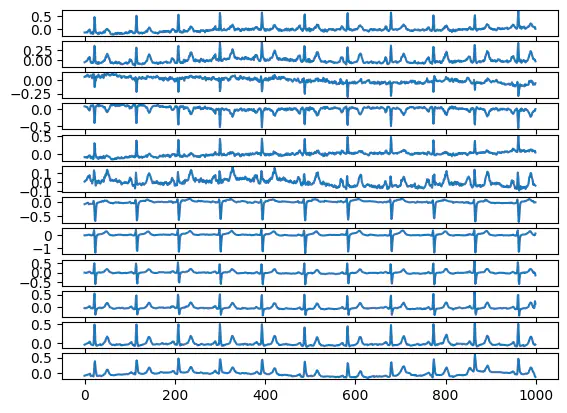 PTB-XL dataset: 21,837 ECG recordings
Published at ETNCC 2024 · IEEE · DOI: 10.1109/ETNCC63262.2024.10767459
Headline numbers
- 80% classification accuracy
- 90% ROC-AUC, the best of all six models tested
- 21,837 ECG records · 18,885 patients · 12-lead · PTB-XL dataset
What it is
ECG-Lense is the deep CNN architecture I built and benchmarked against five other models for classifying cardiac ECG signals. Three classical ML, three deep learning, head-to-head on the same dataset and same metrics. ECG-Lense wins.
| Model | Type |
|---|---|
| Decision Tree | Classical |
| Random Forest | Classical |
| Logistic Regression | Classical |
| Simple CNN | Deep |
| LSTM | Deep |
| ECG-Lense (Complex CNN) | Deep (proposed) |
What I actually did
- Worked off the PTB-XL dataset: clinical 12-lead ECGs, 10 seconds each, sampled at 100 Hz, with hierarchical diagnostic labels (5 superclasses, 24 subclasses)
- Preprocessed signals with
wfdband standard ML libraries - Implemented a stationary wavelet transform (SWT) for data augmentation. The dataset is imbalanced and the augmentation increased sample diversity while preserving signal characteristics
- Trained the deep models on raw ECG signals so feature extraction would be automatic
- Evaluated on accuracy, precision, recall, F1, and ROC-AUC
What broke and what I learned
- Class imbalance was the actual problem. First CNN runs hit a wall around 70% accuracy because rare cardiac classes were under-represented. SWT-based augmentation unlocked the next 10 points.
- Raw signals beat hand-crafted features. Classical ML on extracted features stalled. The deep models, given raw signals, found patterns the feature engineering had thrown away.
- More layers wasn’t the answer. ECG-Lense is “complex” relative to the simple CNN baseline, but each block earns its place. Depth for depth’s sake didn’t help.
Six months of work. A+ thesis grade. Submitted to IEEE during the project, accepted, presented and published at ETNCC 2024.
Stack
Python · TensorFlow · Keras · scikit-learn · MLFlow · wfdb · NumPy · pandas
Acknowledgements
Mentor: Dr. Kamal Kant Hiran (PhD). He pushed me to write the paper, guided the work end-to-end. Supervisors: Alok Kumar, Dr. Chandani Joshi, Harsh Bansal.
Dataset images
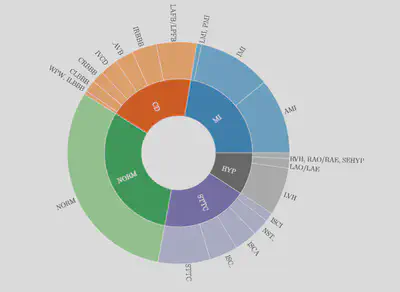
The dataset comprises 21,837 clinical 12-lead ECG records of 10 seconds in length from 18,885 patients. Hierarchical diagnostic organization: 5 superclasses, 24 sub-classes.
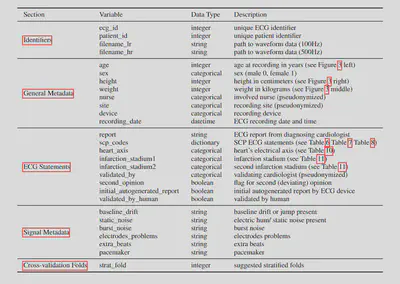
Metadata in
ptbxl_database.csv: each ECG identified by a uniqueecg_idwith SCP codes for multi-label classification.
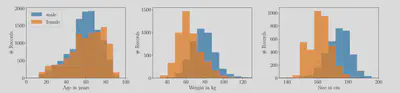
- Demographic overview of patients in PTB-XL.
The dataset comprises 21837 clinical 12-lead ECG records of 10 seconds in length from 18885 patients. For the diagnostic labels, it provides a hierarchical organization in terms of 5 coarse superclasses and 24 sub-classes for the diagnostic labels
Columns provided in the metadata table ptbxl_database.csv. Each ECG is identified by a unique ID (ecg_id) and comes with several ECG statements (scp_codes) that can be used to train a multi-label classifier that can be evaluated based on the proposed fold assignments (strat_fold).
- Demographic overview of patients in PTB-XL.

Ukant Jadia
Backend & AI Engineer · Team Lead, Caprae Capital
AI can ship. I make it earn. Backend & AI engineer and team lead at Caprae Capital. I turn vibe code into production code.